Interventions in Context, Križevci Museum Gallery
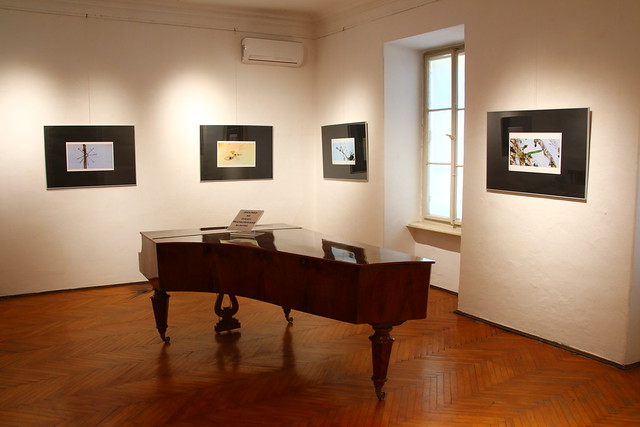
Exhibition Interventions in Context opened in Križevci Museum Gallery on 1st of October 2026. as a part of SUFFEST 2026 (Festival of Contemporary Art Form).
Text from curator Saša Živković:
The Third Path: The Art of Quiet Interventions by Kruno Jošt
While preparing the concept for an exhibition by the multimedia artist Kruno Jošt in Križevci, it was decided that it would take the form of a kind of retrospective survey of his creative output over the past decade. A retrospective conventionally implies exhibitions that speak of an artist’s beginnings, developmental phases, shifts in interest, media, and methods, attempting to find a logic within the artistic oeuvre through chronological sequence. It seemed to us, however, that such an approach in Kruno Jošt’s case might obscure precisely what makes his artistic practice recognizable. Photography, video, sound, performance, installation, digital media, field research, microscopy, and experimental laboratory procedures alternate and interweave in his work, yet none of these media determines his oeuvre as a whole. His method lies rather in a multilayered approach to space and to the system of relations in which he operates.

To understand the logic of such an artistic path, we need to briefly look into Jošt’s biography. Growing up in a family of scientists, in which an affinity for art was simultaneously cultivated, may well have been one of the initial stimuli for his later linking of art and science. His father, Marijan Jošt, a renowned agronomist and geneticist, also engaged with art, and in 1962 held a solo exhibition of sculptures and graphics precisely in the newly renovated building of the City Museum in Križevci.

Even more significant for Kruno’s development was his need to expand both artistic and life horizons. After the Academy of Fine Arts in Zagreb, where Ivan Ladislav Galeta exerted a strong influence on him, he continued his education at the Gerrit Rietveld Academie in Amsterdam, and then at the Transart Institute in Berlin, increasingly orienting himself toward transdisciplinary artistic practices. The Amsterdam experience was important for embracing artistic work as a project capable of unifying research, experiment, and various—especially digital—media. After returning to Croatia in the early 2000s, he collaborated again with Galeta, through whom he became acquainted with permaculture and the concept of deep ecology.
Kruno Jošt’s present position is difficult to separate from Rasoje, a small village near Lovinac in Lika, where he has connected art, ecology, and permaculture. There he built a permacultural homestead and developed the Center for Creative Solutions (C4CS), an off-the-grid space in which artistic practice interweaves with permaculture, education, and the organization of artistic and other events that bring together artists, activists, and volunteers from different parts of the world.
I therefore do not see the exhibition Interventions in Context primarily as a chronological retrospective, but as an opportunity to read a broad spectrum of interests within which the continuity of a single artistic position can nonetheless be recognized. From new media, technology, and autonomous systems, through permaculture, sustainability, and sound experiments, to recent works involving plants, microorganisms, and rivers, there runs through it all a need for the artwork not simply to be placed into a given space, but to emerge from it.
The artist does not come to a place merely to leave his trace there. He allows the place to leave its trace in his work.
This “third path” along which Kruno Jošt moves is a path of freedom and responsibility. Freedom here is understood not only as an artistic principle, but as a mode of everyday life, connected to a striving for autonomy and a responsibility toward the environment fostered by the off-the-grid and permacultural approach. From this arises one of the most intriguing questions of his work: must art necessarily be intended for the human?
The traditional conception of art almost self-evidently presupposes the human at both ends of the communicative process. The human creates and the human observes. The image exists so that we may look at it; music so that we may listen to it. Nature can be motif, material, or space, but rarely becomes an equal participant in the artistic event.
Jošt gradually destabilizes this hierarchy. A plant can be a listener, a microorganism a participant, and a river a site of research, a subject, material, and collaborator—not merely a motif. The human remains present but is no longer necessarily the center of the event.
This turn is especially clear in his long-standing work with sound. In the projects gathered around the concept Sound Fertilizer, sound ceases to be exclusively an aesthetic phenomenon intended for human hearing. Over a series of years, Jošt has developed a series of installations exploring the possibility of sound as a kind of “organic fertilizer”—from early multichannel systems to mobile, solar-powered versions directed toward plants. Behind the provocative name lies a more serious question: can an artistic medium cease to serve solely human aesthetic experience and become a way of establishing relations with other living beings?
In the project Playing for Microbes, realized in 2022 in Sweden, this shift toward a more-than-human world is further radicalized. Its starting points are the Viskan River, its microscopic life, and the problem of polluted sediment connected to the industrial history of the area. Jošt begins from scientific research on the effects of certain frequencies on microorganisms but transposes it into the realm of artistic experiment. It is precisely the space between scientific data, experimental hypothesis, and artistic imagination that becomes productive. Earlier interests in sound, autonomous systems, and a nonhuman audience here meet what will become one of the key motifs of his recent work—the river as a living system.
An important feature of Jošt’s methodology is that he rarely creates a finished work that he then brings to a given location. The process is reversed: arrival at a place initiates research out of which the work is only then to emerge. Context is not the stage for the artwork but its active agent.
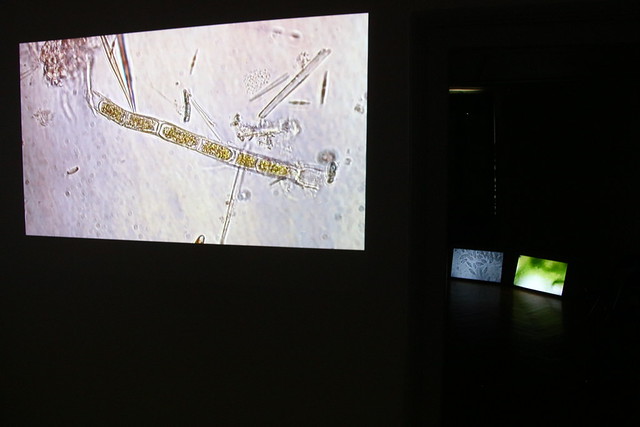
This methodology continues in the projects Concerto Quieto, dedicated to the Mirna River and exhibited in 2025 at the Rigo Gallery in Novigrad, and Composition for the Mura, presented the same year at the Murai Creative-Educational Center in Pleškovac. Both projects demonstrate Jošt’s complex research approach and the establishment of a relationship between macro and micro perspectives. The river we observe as landscape, geographical space, or ecosystem reveals under the microscope another landscape, composed of life forms that have been present all along but remain beyond the limits of our sight.
The ecological engagement of these works remains restrained. There is no expected activist iconography of catastrophe, heaps of waste, or direct warning. Instead of demonstrating the consequences of an anthropocentric relationship toward nature, Jošt changes the scale of our perception. What was too small for us to notice becomes large. What we could not hear receives its concert. And what we simply called “a river” reveals itself as a complex community of life.
Important here is the collaboration with experts and a laboratory. The boundary between the artist’s studio, the scientific laboratory, the riverine landscape, and the gallery becomes permeable, but this does not mean that art becomes science. The value of Jošt’s transdisciplinary approach lies precisely in the fact that it does not attempt to abolish the difference between these fields. Science identifies, measures, and explains. Art can transform the result of such a process into a different question: what happens when what we have identified ceases to be mere data and becomes part of our sensory experience?
Here we return once again to Interventions in Context. An intervention usually implies a gesture by which the artist appropriates, reorganizes, or symbolically transforms a space. With Jošt, the relationship is almost reversed. One must first observe, listen, get to know the place, and recognize the relations that already exist within it. Only then intervene.
Viewed from a retrospective perspective, Jošt’s oeuvre reveals an intriguing paradox: the more technologically, scientifically, and conceptually complex his artistic practice becomes, the quieter his interventions become. This silence is not an absence of action. It is a relinquishing of the need for domination.
Here we can return to Jošt’s idea of the “third path.” The freedom he seeks is not freedom from relations, but a freedom that entails responsibility for the relations we create. In his recent practice, this responsibility extends beyond the human community—toward the plant, the microorganism, water, soil, and systems of which we ourselves are also a part.
To listen means to acknowledge the existence of the other before assigning it our own meaning. It means at least momentarily relinquishing the need to be the only ones who speak. That is why listening seems to me perhaps the most precise metaphor for understanding Kruno’s work.
I therefore do not see Interventions in Context merely as a survey of Kruno Jošt’s works. It poses before us a broader question about the possibility of art in a world in which the human must gradually accept that he is not its sole protagonist.
Perhaps precisely in that connection of freedom and responsibility, of acting and listening, lies the third path of art—and Kruno Jošt is already on that path, on which I believe he will discover still undiscovered horizons of art.