Plants talk

It is speculated that plants can understand and interpret sounds, at wavelengths beyond our capacities. Specific sounds have proven to speed the growth of certain plants – binaural sounds (which are essentially two separate frequencies playing from opposing sides), sounds found in their natural environments, and even white noise – have been shown to positively affect the plant.


Sternheimer composes musical note sequences which help plants grow and has applied for an international patent covering the concept. The sound sequences are not random but are carefully constructed melodies. Each note is chosen to correspond to an amino acid in a protein with the full tune corresponding to the entire protein. What this means is that the sounds sequenced in just the right order results in a tune which is unique and harmonizes with the internal structure of a specific plant type. Each plant type has a different sequence of notes to stimulate its growth.


A research on impatiens and beans was conducted in order to show the effect of sound on plant growth, as well as to see any correlations to the size of the plant. It was found that when the wavelength of the sound waves coincided with the dimensions of the leaf, the effect was the greatest. Essentially, air particles vibrate and move along the surface of the leaf, making a scrubbing action, removing water particles from the surface of the leaf. This allowed the plant to breathe better. Pure tones as well as random noise were used, random noise being detrimental to the growth of the beans.


It’s now well established that when bugs chew leaves, plants respond by releasing volatile organic compounds into the air. By Karban’s last count, 40 out of 48 studies of plant communication confirm that other plants detect these airborne signals and ramp up their production of chemical weapons or other defense mechanisms in response.


Just a few months ago, the plant signaling pioneer Ted Farmer of the University of Lausanne discovered an almost entirely unrecognized way that plants transmit information — with electrical pulses and a system of voltage-based signaling that is eerily reminiscent of the animal nervous system.


Plants can communicate with insects as well, sending airborne messages that act as distress signals to predatory insects that kill herbivores.


The idea that plants communicate with each other is normally based in science-fiction or fantasy, but new research out of The University of Western Australia reveals that this actually may be the case. UWA Postdoctoral Research Fellow Dr. Monica Gagliano has discovered that our green friends not only react to sounds, but they can also communicate with each other via “clicking noises.”


Gardeners have long believed that what music they play affects the growth of their plants, but Dr. Gagliano’s research, done with colleagues Professor Daniel Robert at the University of Bristol (UK) and Professor Stefano Mancuso at the University of Florence (Italy), shows that the roots of young plants emit and react to particular sounds.


While mushrooms might be the most familiar part of a fungus, most of their bodies are made up of a mass of thin threads, known as a mycelium. We now know that these threads act as a kind of underground internet, linking the roots of different plants. That tree in your garden is probably hooked up to a bush several metres away, thanks to mycelia.


Around 90% of land plants are in mutually-beneficial relationships with fungi. The 19th-century German biologist Albert Bernard Frank coined the word “mycorrhiza” to describe these partnerships, in which the fungus colonises the roots of the plant.


A new study conducted by Dr. David Johnson at the University of Aberdeen found that plants actually communicate with one another through the soil. The study shows that when vegetables are infected with certain diseases, they alert other nearby plants to activate genes to ward off the disease when it heads their way. The key to this communication is a soil fungus that acts as a messenger.


When you inhale the sweet smell of freshly mown grass or cut flowers, what you’re actually smelling is the plant’s distress call. It’s the plant’s way of crying out for help.


The invasive knapweed plant—native to Eastern Europe but wrecking havoc on U.S. grasslands—has roots that release certain chemicals to help the plant take in nutrients from the soil. Those same chemicals also kill off native grasses. Thus, the knapweed ends up taking over large territories and killing off its competitors, much like some animals do. Some plants, however, have formed a defense. Lupin roots secrete oxalic acid, which forms a protective barrier against the toxic chemicals given off by knapweed. Lupin can even protect other plants in its vicinity from falling prey to the invasive species.


Plants go out of their way to attract more than just insects. A carnivorous pitcher plant native to Borneo has evolved to hijack bat communication systems, turning the bats’ echolocation to its advantage. According to a new study in Current Biology, Nepenthes hemsleyan has a concave structure that is specially suited to reflect bat echolocation, helping the bats find the plant.


BMC Ecology researchers report a new type of mechanism that some plants use to communicate. The team planted common chili pepper seeds (Capsicum annuum) near a basil plant, with barriers that prevented the basil from deploying its usual growth-promoting tricks. Despite the separation, chili seeds germinated faster when basil was a neighbor, suggesting that a message was getting through. Because light, touch, and chemical “smell” were ruled out, the team proposes that the finding points to a new type of communication between plants, possibly involving nanoscale sound waves, traveling through the dirt to bring encouraging “words” to the growing seeds.


https://www.wired.com/2013/12/secret-language-of-plants/

https://inhabitat.com/plants-can-talk-to-each-other-by-clicking-their-roots/

http://www.bbc.com/earth/story/20141111-plants-have-a-hidden-internet

https://inhabitat.com/plants-talk-to-each-other-through-a-messenger-in-the-soil/

http://mentalfloss.com/article/66302/5-ways-plants-communicate

http://www.huffingtonpost.in/entry/plants-talk-to-each-other-nanoscale-sound-waves-grow_n_3229021


MEMORIES FROM THE PAST

As he looked down from the balcony of his house an obnoxious feeling of disgust and disappointment had clouded his mind of what the future really held for us humans. Kshitij shares some of his past memories that could be taken back to his hometown, Delhi in North India and how this interim had bought a gradual change of realization and desperation for succor in the lives of many. He mentions some of the grim facts that were evoked into his mind regarding the drastic changes humans had caused around their surroundings. Nothing but skyscrapers made of metal and steel looked down upon us, the miasmic smell of the roads made of tar covered the corpses of millions of trees that were hacked and slashed, and these are just a few.

Now it does not matter, years go by and the seasons come and go but the stench of the human mess still refuses to budge. He was once amazed by what humans had accomplished in advanced technology but as they say everything comes at a price and this time it came in the form of a gamble, a gamble for the life of the ecosystem. The smog covers the landscape of his city like a cheap plastic bag that throttles the life of their victims. The so called “trees” in the city look dead and lifeless because of it and its funny when we complain, though isn’t it us who contaminated the skies, isn’t it us who contaminated the soil and the water, then how can we “expect” something from a tree that we have disrespected and disregarded.

The experiences of him being in the city are astounding, he literally treads the city roads in a constant fear of being run over, by people and their huge machines called cars. Things surely have changed and time has taken a toll on us but we too are equally to be blamed. The trees have withered and now its our turn. He just hopes we contemplate on our actions before its too late.


This blogpost was written by Kshitij Chaudhuri (Industrial arts and design practices student) as a part of his assignment for Ecocentric where he dived deep inside to acknowledge his feelings on environment. 

Iteration on gardening

Growing plants or even the fact of ‘gardening’ has never been my cup of tea and since childhood the whole idea of sprouting beans like mustard, rajma, chickpeas or any other kind of sprouts has always annoyed me, honestly the last time I remember doing this was in school.

As a child I never bothered much about nature or the world but just myself, growing these sprouts after what seemed like ages did bring back the old memories but this time it was different. The fact of taking care of a plant is something not as easy as it seemed back in the old days, the fact that it was so annoying was because of the reason that one needed patience, focus and diligence and with that the constant will power of rigorous precision. Waking up early morning I would water the plants, come back home from college and check on them in the evening. Yes, this was a monotonous event that had become an integral part of my life but it sure was enchanting and the best part of my interim. Words are not enough to describe the kind of bond one creates between you and the sprouts but according to me it was more of a symbiotic relationship.

A relationship not only involving the basic needs of water but the needs of emotions like trust, care, affection and cherishing each and every part of knowledge one exchanges between the two such organisms, us and the plants. One reason could be that I recognized them equal to us as individuals rising to maturity or maybe the fact that I considered them as organism who deserved respect and nurturing, after all doesn’t both of our genesis lies in nature itself?

This blogpost was written by Kshitij Chaudhuri (Industrial arts and design practices student) as a part of his assignment for Ecocentric where he dived deep inside to acknowledge his feelings on environment. 

Knock Off 1

In the future, time is not measured in ages of informational and technological development anymore. Time is now measured and understood as ages of geological and climatic change.

We arrive in a world that is already comfortably settled into the new ways and sensibilities of the climatic revolution.  Before, the world pivoted through the power of machines, simulations and statistics. Now, humanity’s every step is dictated by weather anomalies, wind currents and the rising and the ebbing of the tide.Finally knocked off our perch, the human species comes second to the raw force of nature.


This blogpost was written by Rudradutt Ranade (Creative writing) as an Ecocentric project assignment on nature, environment, extinction and apocalypse.
Texts are collaboratevly illustrated by Ishan Srivastava (Digital Media Arts).


Kshitij iterations

<

AVALAHALLI FOREST

Kshitij Chaudhuri’s visit to the Avalahalli state forest was truly a breathtaking opportunity to blend with nature and to be in continuous exposure among the trees, insects, animals and the soil itself on which he stood upon. An awe inspiring trip that really made his mind wonder into the lost fragments of the environment and surroundings that he really had no clue about. Moreover, for him the trip was more of realization rather than just an adventurous and exciting horde of fun filled with energetic events and moments that occurred while being there. Needless to say all that added up to the experiences but can’t consider them as major contributors. There was just more to that, something hard to comprehend or even fathom about it.

It was nature itself, him being there sitting in the forest, feeling the bark of the tree or the organic structures of a leaf through touch, listening to the rustling of the grass in the open meadow or the chirping of the birds and even the way the wind touched the soft but luscious green leaves swinging from the branches. His eyes dancing and being guided by the movement of the leaves as the wind brushed against their intricate form. This is what he went through as he laid down on the rocks. Concentration at first was hard but emptying your mind of all thoughts and letting nature flow into it did do the trick. Cutting of your mind with all the unnecessary emotions and feelings but just being there in the forest he could even sense and make out the point of direction from where the wind blew. 

When was the last time he was exposed to nature at such an extent, oh yes when he was seven and used to traverse the alluring yet at the same time the mystical forest that resided right near  his house back at his hometown. Now the only thing that remains there are building made of nothing but cement and steel. The concrete jungle had taken up the space with wide roads displacing the wonders of nature. And this is exactly the reason why he will remember the visit, for the reminiscence of a grim past but an eye opener for the future. As he puts it “Thank you Avalahalli for a wonderful journey and thank you for welcoming me.”

ABOUT THE INTERIM 

The term ‘Ecocentric’ has really been an intriguing phase and made him really curious not just about what it meant but the fact that what surprises the interim would have in store for him. Also the reason that this term had the hint of nature and the environment around them made him think of the possibilities that it could possibly hold especially with the interaction between humans and plants. This for him was something new a way of communication between the plants and animals that could be done through the medium of music was astonishing. As weeks passed by and his perception of nature kept evolving, changing and modifying to an extent where one can say that there is no objective answer to what nature really is?

Is it the physical world that consists of materialistic things or something more sinister than just imaginations beyond our own reach? Researching more about this he stumbled upon with dozens of translations of it in different languages but one which drew his attention to was the fact that in ancient times it was considered as the ‘origin of birth’. As he says, “the entire existence of us was due to nature and not the other way round. We are a part of it and when we die we become one with it and thats the cycle of life and death. What we are dealing with is a philosophy that places an intrusive value on all living organisms and their natural habitats. The fact that we are experimenting with plants and music is just a part of a bigger collective.”

What he meant by ‘collective’ is that nature which includes the Sun and our Earth are objects crawling with living organisms, us being one of many. We are just a part of a bigger picture and so are the plants and animals. We depend on each other and an imbalance caused by us disturbs the whole foundation of our ecosystem itself. Though we consider ourselves as superior beings but eventually don’t we end up getting eaten up by nature itself? Our bodies decomposes when we die and our manure supplements the roots of trees with nutrients after all we aren’t the masters of nature.

VISIT TO THE ART OF LIVING

Kshitij wouldn’t probably call himself as an atheist since that would comply the fact that he’s a complete non believer in a source, power or entity that is the reason for our existence in this primordial world. He does believe in a higher order or an existence of such a source that stems humans, plants and animals as signs of life into this planet of ours and who knows but maybe nature is that source of life. Instead what astonished him at his visit to The Art of Living was a complete and utter reverence of a human being as a God in the eyes of so many people who had come that day to see Sri Sri Ravi Shankar. He was literally swayed off his feet by the man’s devotion and love for the poor by doing charity work and halted various wars that had consumed countless countries in the deep and dark abyss of darkness.

Sri Sri Ravi Shankar approached as a beacon of hope and light to such places and conquered the hearts of the people with his determination and commitment to humanity. But what he could see was the other side of a portrait, a side that would rather be mentioned as a blind faith or complete shock. It was an honor to see a living legend like Sri Sri Ravi Shankar lost in the beauty of the intoxicating yet divine songs that were sung during the pooja but a mediocracy to impose your will to the level of God. Being at a state of confusion he wondered as how one can judge the appearance of God as a human and who are we to do that. He was bewildered by the fact how much dependency of their faith and belief had been put into a human at such an extent that it brought them from across the globe.

As a simple individual, he would rather not take sides but at best has just put down his own observations throughout his journey. He respects the beliefs and the ways of their faith and it would be only fair as he himself cannot judge their practices or their divine teaching that has been carried on for millennia. Apart from this various other factors were present in the campus, Kshitij was eager to see the cowsheds and the permaculture that was being conducted their. An assortment of various crops and fruits were grown their such as passion fruits, bottle gourd, pumpkins, tomatoes, aloe vera, ladyfinger, gooseberries and many more. They also had a few beehive boxes but sadly without the bees themselves. But what really was amazing was the natural structure of the bees’ home, the wax that they made naturally on the panels that the kind lady held gently in her hands with small shapes of hexagons carved neatly.

Another cherishing experience which came to be a part of his journey was the visit to the cowshed where numerous cows were being taken care of. A man in white kurta told him and his peers regarding the different cows that were held there at the ashram, most of them being Indian cows rich in A2 proteins. The fact that they had the privilege to be present amongst one of the cows who’s ancestors dated back till the time of Lord Krishna himself was an auspicious moment for everyone. The fact that he got the occasion of bonding and connecting with such docile yet sacred creatures was enriching and memorable for him. Also what he learnt from the trip was that music was one medium that they considered vital in the growth of these cows. A healthy cow would be the one that would listen to the songs played by God Krishna himself as the old folk tales of Indian mythology  depicted him of doing so with his flute.

These are few of the memories that he took with him as it was time to say farewell to the people , animals and plants that resided in the protection of the ashram. 

Regards

Kshitij

Avalahalli-forest field trip

On the 29th of November, students of the Ecocentric project took a short trip to Avalahalli forest which is about 30 minutes away from college campus.

There was no fixed itinerary for this trip, and it was made just to get an overall sense of being around nature and the forest. They began the day by helping an old lady (a caretaker of an agricultural plot) harvest Ragi.The Ragi pods are easily recognizable, as they come off in brown clumps, and by rolling the pods in one’s hands, one is able to extract the Ragi easily.Then, we collected all the waste that lay around in a plastic bag. Although this was forest/agricultural land, the reach of humans was still evident by the large amounts of plastic left behind. We continued to carry plastic all through our walk.
We headed towards a dense growth of Eucalyptus trees, where we gathered and discussed certain patterns and facts of the forest that we had observed.

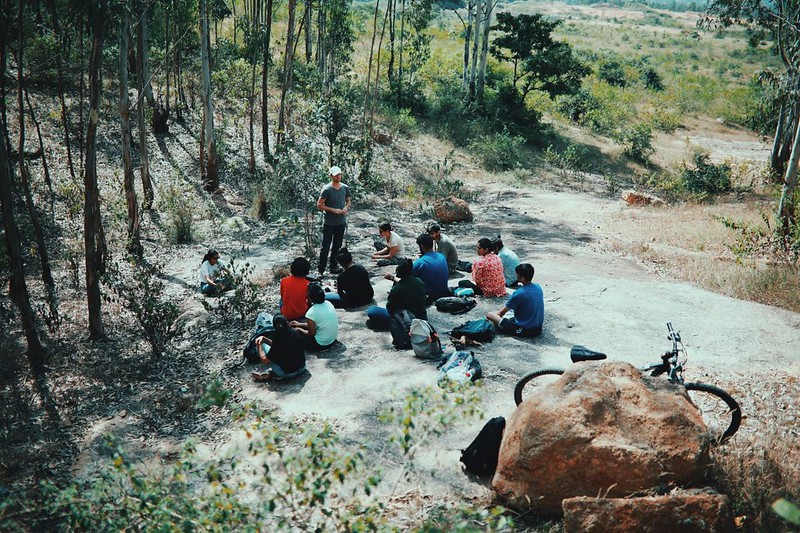
It was also interesting to note the natural patterns made on the forest floor by many years of fallen leaves and natural mulching that had taken place. We collected many samples of bark, quartz pieces, and even feathers.

Soon after our session, we broke for lunch. After lunch, we had a quiet session where everyone laid down and listened to the sounds of the forest. There was a strange natural rhythm that the forest had, which none of us had noticed before.  The passage of the wind through the leaves almost had a musical effect on the ears. After having listened to the forest, we were asked to replicate the noises we heard. We discussed using natural noises as a background for our final installation.

Sound and plants

Many researches have shown how sound can help the growth of a plant. It is speculated that plants can understand and interpret sounds, at wavelengths beyond our capacities. Specific sounds have proven to speed the growth of certain plants: binaural sounds, which are essentially two separate frequencies playing from opposing sides, sounds found in their natural environments, and even white noise, have shown to positively affect the plant.