Project Ecocentric is part of the Srishti Interim, headed by visiting artist Kruno Jošt and ecologist Lana Novosel from Croatia and permanent faculty Prakrithy Pradeep, a permanent facility in Srishti Institute of Art, Design and Technology, Bangalore, India. Ecocentric is a four week project that spans from 22nd November to 16th December 2017 and is part of Srishti’s Interim conducted at N5 campus of Srishti University, Bangalore, India.
Project Ecocentric is informed by a growing need of artistic responses to the questions introduced by Anthropocentric concepts (and practices) and its counterpart ecocentrism. The premise throughout the last few centuries was that art is a form of communication between humans, and more recently between humans and machines. Ecocentrism is grounded in belief that, compared to the undoubted importance of the human component, the whole ecosphere is even more significant and consequential; more inclusive, more complex, more integrated, more creative, more beautiful, more mysterious. Ecocentric, thus, explores and finds ways to create art made by humans for plants.
The project includes research, dialogue, recording images (moving and still) and sounds, note-taking, editing and implementation. Students and visiting artists visited the nearby Avalahalli Forest on 29th November, the Art of Living ashram on 1st December and Ee-eye Ee-eye Oh Farms on 5th December as part of field trip exercises. Field trips help research and document different practices in connection to human and plant/animal communication, and questions the viewer’s position in the art operating systems.
Human communication is often misrepresented as a sign of intelligence that caters to our need to dominate over other forms of life. We keep forgetting that other species also use communication and sound, which is even noticed in the plant world. India’s deep verbal history connects worlds of humans and non-humans.
Students: Aditi Boggaram (Public space design), Antara Raman (Visual communication and strategic branding), Arianth Tejas Belliraj (Contemporary art practise), C Nikitha (Industrial art and design practise), Gajal Jain (Industrial art and design practise), Ishan Srivastava (Experimental media arts), Kshitij Chaudhuri (Industrial arts and design practises), Lakshmi Mrugendra Behere (Industrial arts and design practises), Matthew Arnold Mata (Contemporary art practise), Neeraj Saraswat (Film), Rudradutt Ranade (Creative writing), Shraddha Rastogi (Experimental media arts), Shrishti Kedlaya (Industrial arts and design practise), Swarnima Bavadeep (Industrial arts and design practise), Tirtharaj Paul (Visual communication and strategic branding).

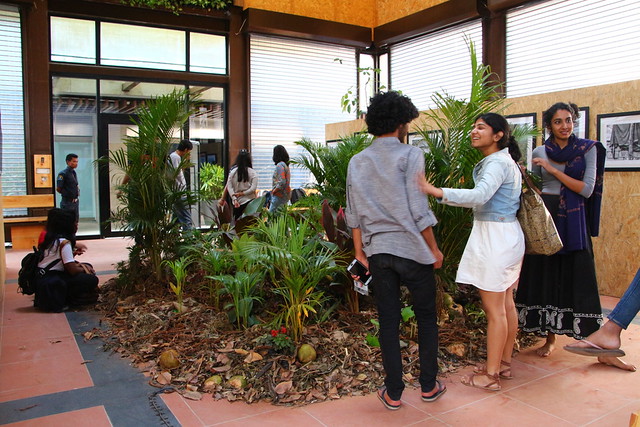
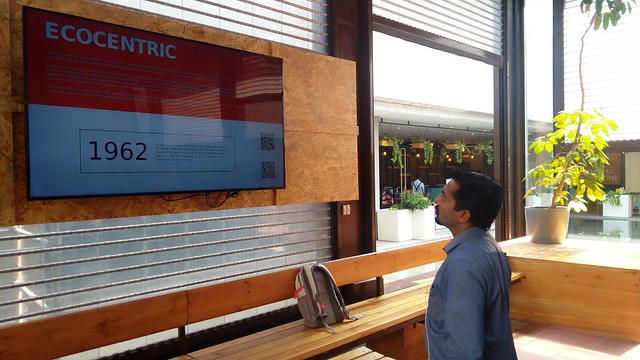


 There was also a small herb garden and a single bee hive for cross pollination which housed the indigenous species Apis Cerana Indica. This species, having adapted to the Indian subcontinent has developed ways to avoid being eaten by Bee Eaters by flying in a random motion, which confuses the bird and reduces its chances of catching the bee. The mistake that people make by breeding the Italian bees (Apis Mellifera) in India is that these bees only know how to fly in straight lines, and therefore are an easy catch for birds.

