<
AVALAHALLI FOREST
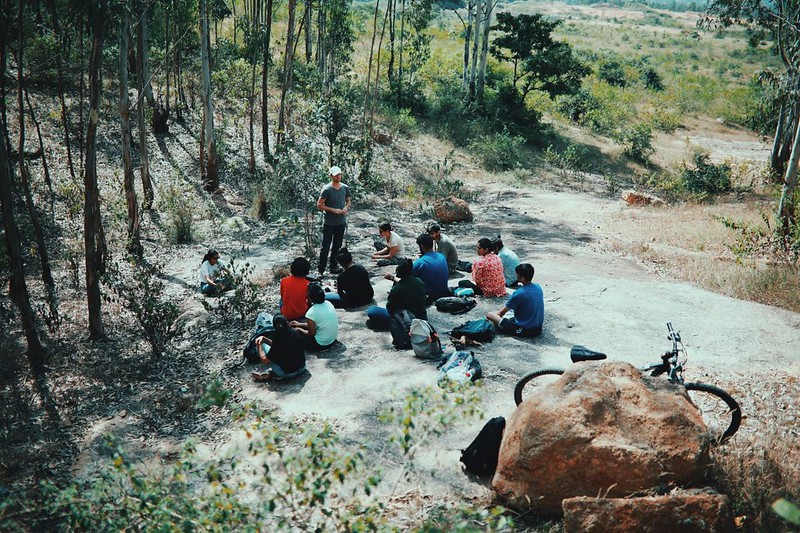
Kshitij Chaudhuri’s visit to the Avalahalli state forest was truly a breathtaking opportunity to blend with nature and to be in continuous exposure among the trees, insects, animals and the soil itself on which he stood upon. An awe inspiring trip that really made his mind wonder into the lost fragments of the environment and surroundings that he really had no clue about. Moreover, for him the trip was more of realization rather than just an adventurous and exciting horde of fun filled with energetic events and moments that occurred while being there. Needless to say all that added up to the experiences but can’t consider them as major contributors. There was just more to that, something hard to comprehend or even fathom about it.
It was nature itself, him being there sitting in the forest, feeling the bark of the tree or the organic structures of a leaf through touch, listening to the rustling of the grass in the open meadow or the chirping of the birds and even the way the wind touched the soft but luscious green leaves swinging from the branches. His eyes dancing and being guided by the movement of the leaves as the wind brushed against their intricate form. This is what he went through as he laid down on the rocks. Concentration at first was hard but emptying your mind of all thoughts and letting nature flow into it did do the trick. Cutting of your mind with all the unnecessary emotions and feelings but just being there in the forest he could even sense and make out the point of direction from where the wind blew.
When was the last time he was exposed to nature at such an extent, oh yes when he was seven and used to traverse the alluring yet at the same time the mystical forest that resided right near his house back at his hometown. Now the only thing that remains there are building made of nothing but cement and steel. The concrete jungle had taken up the space with wide roads displacing the wonders of nature. And this is exactly the reason why he will remember the visit, for the reminiscence of a grim past but an eye opener for the future. As he puts it “Thank you Avalahalli for a wonderful journey and thank you for welcoming me.”
ABOUT THE INTERIM
The term ‘Ecocentric’ has really been an intriguing phase and made him really curious not just about what it meant but the fact that what surprises the interim would have in store for him. Also the reason that this term had the hint of nature and the environment around them made him think of the possibilities that it could possibly hold especially with the interaction between humans and plants. This for him was something new a way of communication between the plants and animals that could be done through the medium of music was astonishing. As weeks passed by and his perception of nature kept evolving, changing and modifying to an extent where one can say that there is no objective answer to what nature really is?
Is it the physical world that consists of materialistic things or something more sinister than just imaginations beyond our own reach? Researching more about this he stumbled upon with dozens of translations of it in different languages but one which drew his attention to was the fact that in ancient times it was considered as the ‘origin of birth’. As he says, “the entire existence of us was due to nature and not the other way round. We are a part of it and when we die we become one with it and thats the cycle of life and death. What we are dealing with is a philosophy that places an intrusive value on all living organisms and their natural habitats. The fact that we are experimenting with plants and music is just a part of a bigger collective.”
What he meant by ‘collective’ is that nature which includes the Sun and our Earth are objects crawling with living organisms, us being one of many. We are just a part of a bigger picture and so are the plants and animals. We depend on each other and an imbalance caused by us disturbs the whole foundation of our ecosystem itself. Though we consider ourselves as superior beings but eventually don’t we end up getting eaten up by nature itself? Our bodies decomposes when we die and our manure supplements the roots of trees with nutrients after all we aren’t the masters of nature.
VISIT TO THE ART OF LIVING
Kshitij wouldn’t probably call himself as an atheist since that would comply the fact that he’s a complete non believer in a source, power or entity that is the reason for our existence in this primordial world. He does believe in a higher order or an existence of such a source that stems humans, plants and animals as signs of life into this planet of ours and who knows but maybe nature is that source of life. Instead what astonished him at his visit to The Art of Living was a complete and utter reverence of a human being as a God in the eyes of so many people who had come that day to see Sri Sri Ravi Shankar. He was literally swayed off his feet by the man’s devotion and love for the poor by doing charity work and halted various wars that had consumed countless countries in the deep and dark abyss of darkness.
Sri Sri Ravi Shankar approached as a beacon of hope and light to such places and conquered the hearts of the people with his determination and commitment to humanity. But what he could see was the other side of a portrait, a side that would rather be mentioned as a blind faith or complete shock. It was an honor to see a living legend like Sri Sri Ravi Shankar lost in the beauty of the intoxicating yet divine songs that were sung during the pooja but a mediocracy to impose your will to the level of God. Being at a state of confusion he wondered as how one can judge the appearance of God as a human and who are we to do that. He was bewildered by the fact how much dependency of their faith and belief had been put into a human at such an extent that it brought them from across the globe.
As a simple individual, he would rather not take sides but at best has just put down his own observations throughout his journey. He respects the beliefs and the ways of their faith and it would be only fair as he himself cannot judge their practices or their divine teaching that has been carried on for millennia. Apart from this various other factors were present in the campus, Kshitij was eager to see the cowsheds and the permaculture that was being conducted their. An assortment of various crops and fruits were grown their such as passion fruits, bottle gourd, pumpkins, tomatoes, aloe vera, ladyfinger, gooseberries and many more. They also had a few beehive boxes but sadly without the bees themselves. But what really was amazing was the natural structure of the bees’ home, the wax that they made naturally on the panels that the kind lady held gently in her hands with small shapes of hexagons carved neatly.
Another cherishing experience which came to be a part of his journey was the visit to the cowshed where numerous cows were being taken care of. A man in white kurta told him and his peers regarding the different cows that were held there at the ashram, most of them being Indian cows rich in A2 proteins. The fact that they had the privilege to be present amongst one of the cows who’s ancestors dated back till the time of Lord Krishna himself was an auspicious moment for everyone. The fact that he got the occasion of bonding and connecting with such docile yet sacred creatures was enriching and memorable for him. Also what he learnt from the trip was that music was one medium that they considered vital in the growth of these cows. A healthy cow would be the one that would listen to the songs played by God Krishna himself as the old folk tales of Indian mythology depicted him of doing so with his flute.
These are few of the memories that he took with him as it was time to say farewell to the people , animals and plants that resided in the protection of the ashram.
Regards
Kshitij


 There was also a small herb garden and a single bee hive for cross pollination which housed the indigenous species Apis Cerana Indica. This species, having adapted to the Indian subcontinent has developed ways to avoid being eaten by Bee Eaters by flying in a random motion, which confuses the bird and reduces its chances of catching the bee. The mistake that people make by breeding the Italian bees (Apis Mellifera) in India is that these bees only know how to fly in straight lines, and therefore are an easy catch for birds.


 On the 29th of November, students of the Ecocentric project took a short trip to Avalahalli forest which is about 30 minutes away from college campus.
 The Ragi pods are easily recognizable, as they come off in brown clumps, and by rolling the pods in one’s hands, one is able to extract the Ragi easily.
 Then, we collected all the waste that lay around in a plastic bag. Although this was forest/agricultural land, the reach of humans was still evident by the large amounts of plastic left behind. We continued to carry plastic all through our walk.
 We headed towards a dense growth of Eucalyptus trees, where we gathered and discussed certain patterns and facts of the forest that we had observed.