Ecocentric students and visiting artist went on 5th December to field trip visiting organic farm a little out of Bangalore on the road to Mangalore. The farm produced organic vegetables and herbs on a reasonably moderate scale, and was managed by a family of three, who continually shuttle between the city and the farm.

Group was initially given a brief about organic farming before taken around the farm. The owner spoke about organic farming, and helped the group to formulate some ideas that could be invested in the final installation. Owner, Mr. Sudeep took the group trough the Groundnuts, Avrekai, Toor Dal, Coconut, tomato, passion fruit, papaya, mango, and avocado.
 There was also a small herb garden and a single bee hive for cross pollination which housed the indigenous species Apis Cerana Indica. This species, having adapted to the Indian subcontinent has developed ways to avoid being eaten by Bee Eaters by flying in a random motion, which confuses the bird and reduces its chances of catching the bee. The mistake that people make by breeding the Italian bees (Apis Mellifera) in India is that these bees only know how to fly in straight lines, and therefore are an easy catch for birds.

In the afternoon group participated in a farming activity, where Avrekai and Groundnut seeds were planted.

These seeds have been prepared with a special bacterial powder beforehand, to ensure growth. Also, harvesting Toor dal was conducted.

From this experience group learned the practical process of growing plants and also the patience and investment it requires in order to grow and maintain farms.


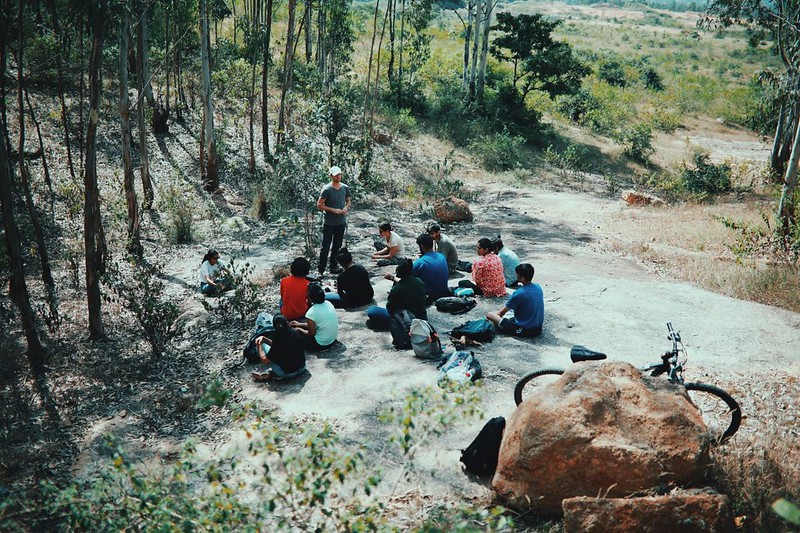
 On the 29th of November, students of the Ecocentric project took a short trip to Avalahalli forest which is about 30 minutes away from college campus.
 The Ragi pods are easily recognizable, as they come off in brown clumps, and by rolling the pods in one’s hands, one is able to extract the Ragi easily.
 Then, we collected all the waste that lay around in a plastic bag. Although this was forest/agricultural land, the reach of humans was still evident by the large amounts of plastic left behind. We continued to carry plastic all through our walk.
 We headed towards a dense growth of Eucalyptus trees, where we gathered and discussed certain patterns and facts of the forest that we had observed.