For our second field visit, we went to the Art of Living Ashram on Kanakapura road on the 1st of December. The objective of this visit was to learn about tradition of dialog between humans and non-humans through visiting gaushala and research on using vibration and sound in human/animal communication.

Ashram itself is a self-sustainable system, using renewables, powered by solar panels, with a permacultural farm, using compost/bio waste to produce bio gas , recycling plastic to produce fuel, producing most of the food they need on their organic and permacultural farm. In all aspects of their work they use holistic approach, also with plants and animals, and through the visit of the permacultural farm in ashram, we really got a chance to experience what eco-centric means.

Most important part of our visit was spent in the Gaushala and permacultural farm. The Gaushala at the Art of Living houses 40 different varieties of indigenous cattle. The cows too have benefited from the practices at the Ashram. Special Bhajans (separate ones for the morning and evening) are played to the cows on speakers, and the cows have scientifically been proven to be healthier and produce better milk as a consequence of daily exposures to thse vibrations. They particularly like to listen to the flute, as the manager Chandu Bhaiyya informed us. He also unveiled in detail the benefits of owning a cow, and how the cow has the unique insight of a mother (as when a cow licks your hand, she is able to tell what obstructs your happiness, and provides the kind of milk that will get rid of such impediments). We even had a session where we got to interact with the cows, pet them, and speak to them, which was quite special for most of us.

We also made a brief visit to a renewable energy converter, which turned a certain variety of plastic into energy that was used to run the kitchen stoves.
Our final stop was the permaculturural farm, where we were told about how it is done and how it works. We learned that permaculture is a self-sustaining agricultural model wherein different plants are grown in tandem, which ultimately benefits the yield of the entire crop. Permaculture farms do not typically look like the manicured, neatly ploughed land we are so used to seeing, but more like a thick growth of vegetation within which edible crops are grown. In the Ashram, there was even a small apiary, which helped to sustain the farm all by itself, as the bees help to pollinate and germinate new plants. The farm had a natural pond as well, which kept the moisture in the area, and helped bring in birds and other animals such as frogs and lizards that in turn ate the pests from the plants, thereby mitigating the need for pesticides. We were also introduced to swales, which are underground ridges constructed to stop water flow when the rainy season comes. This prevents the water from gushing into the farm and washing away/drowning the plants and stagnating. The plants we saw in the farm were pumpkin, tomato, passion fruit, aloe vera, bottlegourd, amla, and papaya, to name a few.
We ended our trip with a tasting of some of the fruits from the permacultural farm.
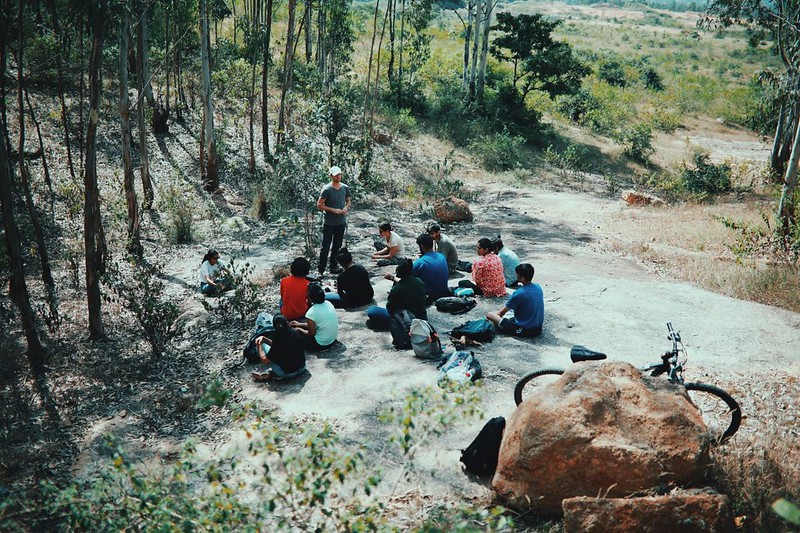
 On the 29th of November, students of the Ecocentric project took a short trip to Avalahalli forest which is about 30 minutes away from college campus.
 The Ragi pods are easily recognizable, as they come off in brown clumps, and by rolling the pods in one’s hands, one is able to extract the Ragi easily.
 Then, we collected all the waste that lay around in a plastic bag. Although this was forest/agricultural land, the reach of humans was still evident by the large amounts of plastic left behind. We continued to carry plastic all through our walk.
 We headed towards a dense growth of Eucalyptus trees, where we gathered and discussed certain patterns and facts of the forest that we had observed.